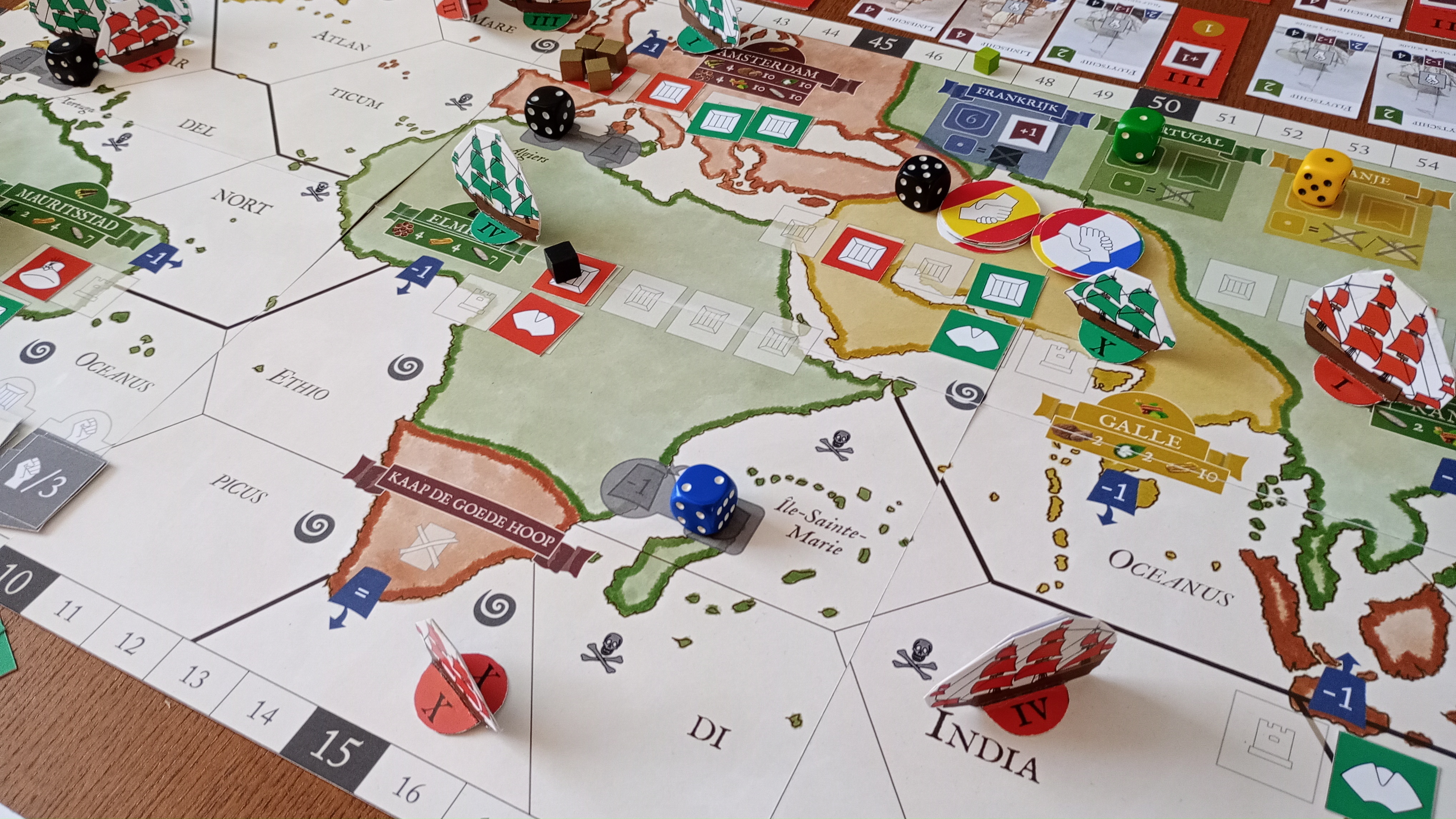
Strategic and tactical board game about the Dutch merchant fleets during the Dutch Golden Age.
Each player controls fleets to compete for big profits, battle victories and settlement control. Go aggressive, be the pacifist or end up somewhere inbetween. Plan ahead through the weather, but be wary of pirates, stockpiles and other nations.
Originally designed as more of a wargame about 17th century ships, over time this turned into a more thematically accurate game about the Dutch East and West India companies with Euro elements (no player elimination, catchup mechanisms).
back to homepage
Very first prototype (2013-2014?). The idea was to design a game around naval trade and battles, not yet involving the Dutch Golden Age. Players moved between imaginary islands shipping spices and building trading posts with functional markets.
The basic gameplay relies on the pick-up-and-deliver mechanic. You take goods, move to another port and deliver goods. Storm-, battle damage and mutiny can cause ships to sink, lost or be captured by pirates.
Ports can be developed with factories (warehouses), officials and building a fortress. During the game there's a variety of technologies and developments available to research.
On top of all this there's a battle model reflecting the actual naval strategies from the era, giving you plenty of opportunities to defeat pirates, other naval empires or competing companies.

Second prototype, based on a loose world map. I started way to early on the visual design, didn't see more potential in a board with this many spaces, so I decided to start over.
Early printing resulted in a few prints that only survived a few tests before being scrapped altogether.
Despite the game being a reasonably good system at this point, there were a lot of issues. The biggest one was probably that of "too many squares", and often forgetting where you came from when wanting to roll back a move.
Fishing (bottom left in above prototype, herring icons) was also entirely dropped as this was less of a focus of the companies and more often a local endeavour.

The basis of what was to come. A handdrawn, modular board to quickly try new mechanics with larger spaces for easier battles and less calculation and clutter.
An early compromise was removing possible player elimination but still running the risk of being "eliminated". At first this was done by having an option to become the pirates after you lost all of your ships, which was never liked. Later I discovered the come up of insurance companies around that time, so lost ships and goods paid out an insurance fee.

A redesign that was used a couple of months introducing a lot of systems that improved on the early concept. Especially a new market system rotating tiles (square white tiles) to simulate supply and demand.
In the past prototypes, upkeep was often problematic. Either there was too much (First Prints above) or there were components that were easily bumped over or forgotten (like the rotating diamond white tiles in the above prototype).
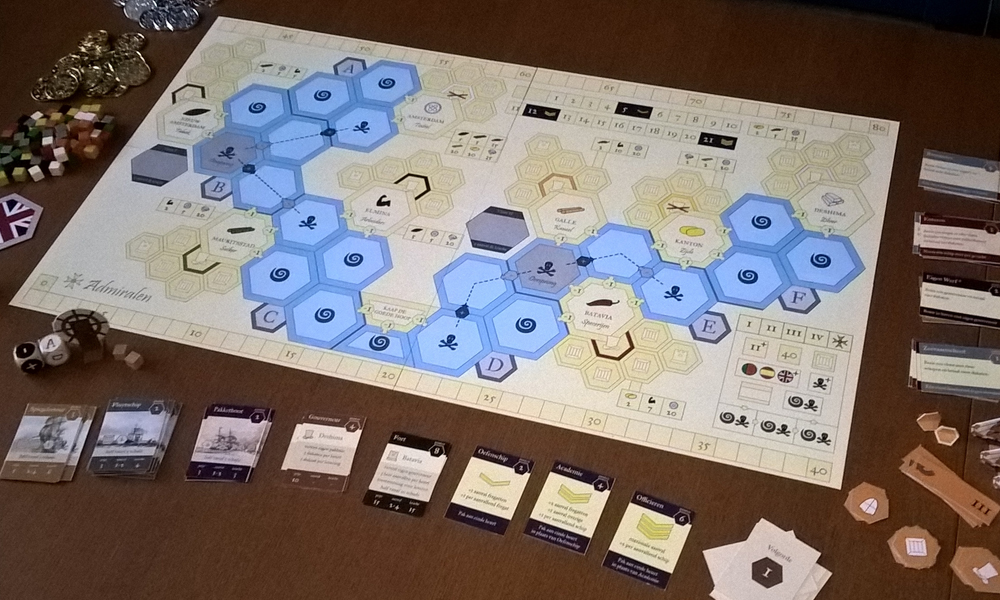
Since I started printing things way too early in the development cycle of this game, this print was significant because the overall design held up for the longest, and isn't far from the final product.
I've worked over ten years on this game, with pauses in between. Sometimes the game was packed away for over a year, and only from about 2018 on it was played (almost) weekly. This was also the period where most of the balancing changes have been made.
From about mid 2022 it was less and less played when I started working on other games. Only in december 2022 the battle model was finished, the solo campaign is yet to be developed.
Most of the game has reached an almost final state. Most of the artwork on the boards, pieces and cards has to be replaced by handdrawn icons and backgrounds.
Balancing in the early game was mostly about ship abilities and commodity values. Later it became important to stop the snowballing of already powerful players and abilities of the developments and technologies.
With no limits regarding the number of ships a player may have, the game's systems now limit the player due to some laws of impeding progress, while still allowing for a high variety of options.
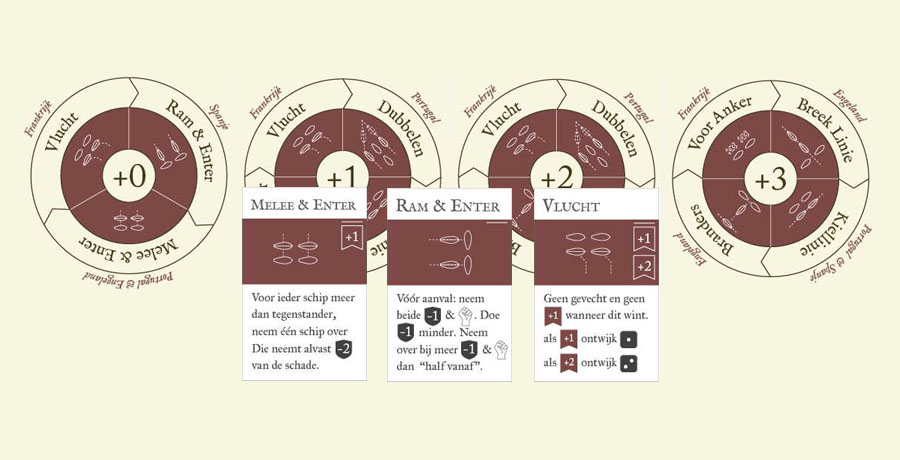
Probably the highlight of the game, even though sometimes hardly used during a game, is the battle model. Based on graphs of actual strategy books from the time, players choose one of eight battle cards depending on the fighting ability of their fleet.
Every fleet can only choose a tactic up to that fleet's level. This provides both a stable predictability with a bit of a surprise element, as sometimes an opponent might choose a
Two composers were also known for their involvement in buying factories of instruments, which in the game sees a few new mechanics as well in buying shares in factories that may or may not benefit you based on the economical state of that city.
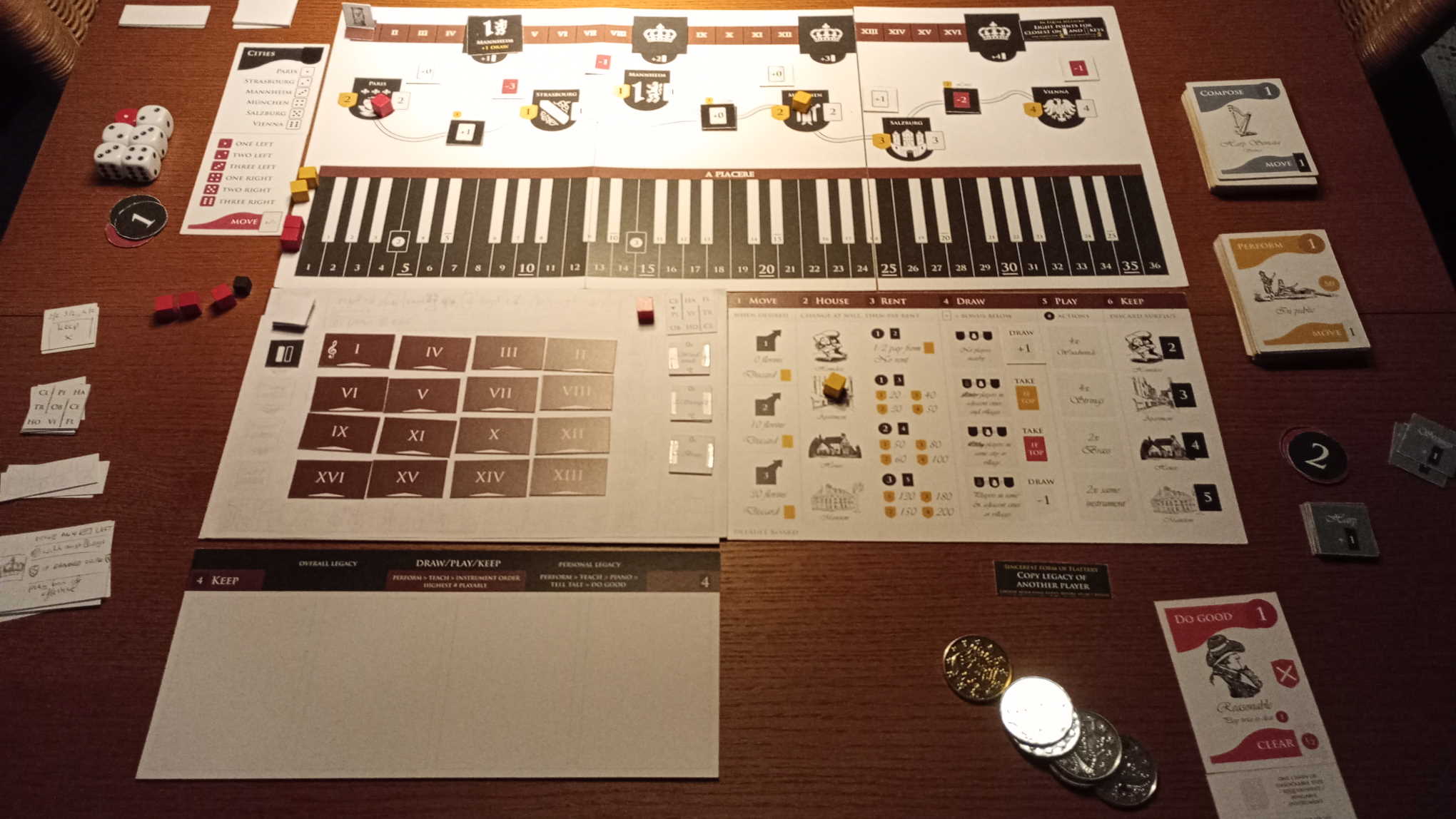
About halfway done. This will be a replayable campaign where the player will play through actual campaigns that the Dutch companies undertook to gain or lose control from competiting companies of other naval heavyweights.
Final art, rewriting of battle cards, solo campaign and refining the solo campaign rules.
back to homepage